January 1973 by James Robenalt
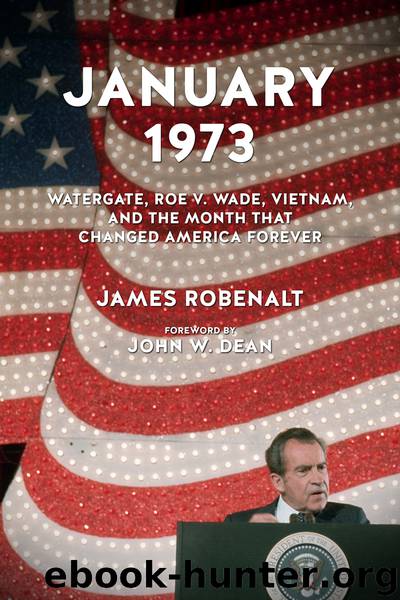
Author:James Robenalt
Language: eng
Format: epub
Publisher: Chicago Review Press
Published: 2015-04-15T16:00:00+00:00
Paris, End of Day, January 10
“Today’s four-hour session continued the momentum of yesterday,” Kissinger cheerily cabled a few hours later. It was evening in Paris but mid-afternoon in Washington—there was a six-hour time difference. “Whatever the press and other observers may say about our military actions, they certainly seem to have contributed to this result,” he wrote. It was as if he somehow knew what Haldeman and Nixon had been discussing that very afternoon in the Oval Office.
Kissinger thought that, given the accelerated pace of discussions, he might wrap things up in time to return to the United States on Saturday, January 13, one week before the inauguration.
In light of Le Duc Tho’s willingness to entertain a signing ceremony in Paris, Kissinger sketched out a proposed new schedule for Nixon to consider. He would return to the United States on January 13. Haig would be briefed and leave for Saigon with the president’s ultimatum the next day, Sunday, January 14. On Monday, an announcement would be made that the United States had halted bombing due to progress in Paris. Haig would return to Washington by Wednesday or Thursday at the latest. On Friday, the day before the inauguration, the White House would announce Kissinger’s return to Paris on Monday, January 22, to conclude negotiations.
The initialing in Paris would be followed by a more formal signing ceremony at the end of the week, on Saturday, January 27. Kissinger would then travel to Hanoi sometime around February 1.5
Kissinger’s cable, received in Washington around 3:00 PM, set off a new round of Nixonian mania over the prospect that Kissinger would overshadow the president. Nixon’s anxiety was that Kissinger would initial the agreement before he had a chance to announce it to the American people. A presidential announcement after the initialing “would then be sort of an anticlimactic nothing” Nixon said to Haldeman in a phone call. “I mean, what the hell am I announcing? The word would go out from there—an agreement has been reached. So the president goes on for what purpose?” Haldeman, this time, shared the president’s concern. “You can’t go on TV to explain Henry’s agreement.” Nixon said it was vitally important that he be in a position to speak first.6
Haig joined a meeting with Haldeman and the president and was assigned the task of responding to Kissinger’s cable. With his return message to Kissinger, Haig appended his own private note. “Attached is a message from the President,” Haig began, “which was dictated in substance following a lengthy and tortuous meeting between the President, Haldeman, and myself addressing Hakto 14 [Henry Kissinger’s cable to the president earlier that day].” Haig said that Nixon was “very concerned that his public statement following the initialing in Paris would be a total flop. It would occur after all the peace euphoria had peaked off. He is also adamant about making the announcement if we succeed prior to the inaugural.”
Haig then assured Kissinger that he had gone out of his way in the meeting to make certain that Kissinger would be back in Washington for the inaugural.
Download
This site does not store any files on its server. We only index and link to content provided by other sites. Please contact the content providers to delete copyright contents if any and email us, we'll remove relevant links or contents immediately.
| Canada | Caribbean & West Indies |
| Central America | Greenland |
| Mexico | Native American |
| South America | United States |
Cat's cradle by Kurt Vonnegut(15365)
Pimp by Iceberg Slim(14523)
4 3 2 1: A Novel by Paul Auster(12405)
Underground: A Human History of the Worlds Beneath Our Feet by Will Hunt(12101)
The Radium Girls by Kate Moore(12036)
Wiseguy by Nicholas Pileggi(5795)
The Fire Next Time by James Baldwin(5454)
Perfect Rhythm by Jae(5415)
American History Stories, Volume III (Yesterday's Classics) by Pratt Mara L(5312)
Paper Towns by Green John(5196)
Pale Blue Dot by Carl Sagan(5013)
A Higher Loyalty: Truth, Lies, and Leadership by James Comey(4967)
The Mayflower and the Pilgrims' New World by Nathaniel Philbrick(4509)
The Doomsday Machine by Daniel Ellsberg(4493)
Killers of the Flower Moon: The Osage Murders and the Birth of the FBI by David Grann(4451)
The Sympathizer by Viet Thanh Nguyen(4398)
Too Much and Not the Mood by Durga Chew-Bose(4353)
The Borden Murders by Sarah Miller(4330)
Sticky Fingers by Joe Hagan(4208)
